Web3: Background and Introduction
Purpose of the internet and arpanet
The purpose of the Internet, as initially conceived, was to create a network of interconnected computers that could communicate with each other seamlessly, regardless of their geographical location or differences in hardware and software. This vision was driven by the need for secure and efficient communication between researchers and scientists at different institutions, particularly during the Cold War era.123
Web1: The Read-Only Web (1990-2004)
In the early 1990s, Tim Berners-Lee developed the protocols that would become the World Wide Web at CERN in Geneva. His vision was to create open, decentralized protocols that allowed information sharing from anywhere on Earth 4. This first iteration, now known as Web1, was characterized by static websites owned by companies, with minimal interactivity between users. Individuals seldom produced content, leading to it being known as the read-only web 456.
Web1 can be likened to a large, curated "walled garden" where users could browse and consume content but had limited ability to interact or contribute. It was similar to reading articles in a magazine, where the content was presented without opportunities for feedback or engagement 7.
Web2: The Read-Write Web (2004-Present)
The emergence of social media platforms marked the transition to Web2. Starting around 2004, this phase allowed users not only to consume content but also to create and share it. The web evolved from read-only to read-write, enabling user-generated content and user-to-user interactions 4568.
Web2 introduced dynamic websites and applications that responded to user input, leading to the rise of blogs, forums, and social media platforms like Facebook, Twitter, and Instagram 67. This interactivity created a more personalized browsing experience. However, it also led to concerns over centralization, data privacy, and the exploitation of user data by tech giants for advertising revenue 89.
Issues on Web2
Companies like Facebook and Google offered free services in exchange for user data, which they packaged for advertisers to create targeted marketing campaigns. This practice raised issues of data privacy and ownership, as users did not have control over their content or benefit from its monetization 489. Additionally, the algorithms used by these platforms often promoted inflammatory content, leading to concerns about mental health, political polarization, and the creation of new "walled gardens" controlled by a few large corporations 89.
Web3: The Read-Write-Own Web
Web3 represents the next evolution of the internet, focusing on decentralization and shifting power from big tech companies to individual users 56810. Coined by Ethereum co-founder Gavin Wood in 2014, Web3 envisions an internet where users have direct ownership over their digital identity and assets, without the need for intermediaries or third parties 46810.
Key principles of Web3 include:
- Decentralization: Ownership and control are distributed among users and builders, rather than centralized entities 4568.
- Permissionless Access: Everyone has equal access to participate in Web3 without exclusion 45.
- Native Payments: Web3 utilizes cryptocurrencies for online spending and transactions, eliminating the need for traditional banking infrastructure 4810.
- Trustlessness: Operations are conducted using incentives and economic mechanisms, not relying on trusted third parties 45.
In Web3, users can participate in the governance and operation of decentralized networks through tokens or cryptocurrencies, effectively becoming participants and shareholders rather than just customers or products 68. Decentralized applications (dApps) are governed by cooperative structures where decisions are made openly by token holders, enhancing transparency and community involvement 89. This model aims to reduce the reliance on big tech companies and give users more control over their data and online interactions.
Blockchain technology underpins Web3, enabling features like Non-Fungible Tokens (NFTs) to establish ownership and trade unique digital assets, aligning with Web3's focus on user control and decentralization 58. Cryptocurrencies serve as the native payment system, enabling decentralized peer-to-peer transactions 58.
Challenges and Limitations
While Web3 holds promise, it faces challenges such as:
- Accessibility: Scalability issues and high transaction fees can hinder widespread adoption. Solutions like Layer 2 protocols aim to address these concerns 4.
- User Experience: Balancing usability and security remains a challenge, highlighting the need for ongoing education and user-friendly designs 4.
- Centralized Infrastructure: Despite decentralization goals, some aspects of Web3 still rely on centralized services, which can be points of failure or control 4.
- Unequal Ownership: There are concerns about unequal distribution of tokens and resources, leading to potential centralization of power among a few entities 5.
- Technical Barriers: Creating and maintaining blockchain networks often require specialized engineering expertise, posing high barriers to entry 5.
Dapps Structure
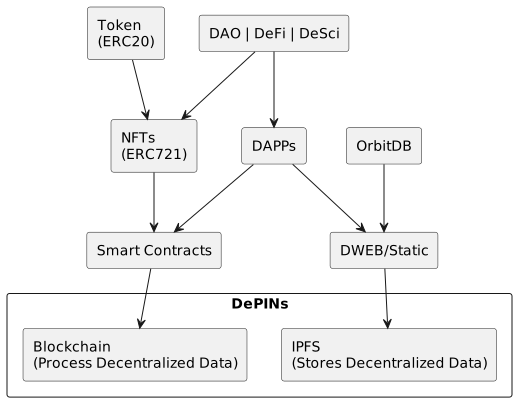
Img1. Shows relations of some technologies for building web3/dapps
@startuml
skinparam arrowStyle classical

rectangle "DAO | DeFi | DeSci" as DefiDao {
}

rectangle "Token\n(ERC20)" as Token {
}

rectangle "NFTs\n(ERC721)" as NFT {
}

rectangle "DAPPs" as Dapps {
}

rectangle "OrbitDB" as OrbitDB {
}

rectangle "Smart Contracts" as SmartContracts {
}

rectangle "DWEB/Static" as DWeb {
}

rectangle "DePINs"{
rectangle "Blockchain\n(Process Decentralized Data)" as Blockchain {
}

rectangle "IPFS\n(Stores Decentralized Data)" as IPFS {
}

DefiDao --> NFT
DefiDao --> Dapps
Token --> NFT
NFT --> SmartContracts
SmartContracts --> Blockchain
Dapps --> SmartContracts
Dapps --> DWeb
OrbitDB --> DWeb
DWeb --> IPFS

@enduml
Listing 1. PlantUML Code to generate Img 1.